

Why Pool Competitions Are a Great Place to Start as an Athlete

Have you ever thought about competing?
By Jeremy Storton
Editor Deena Lynch
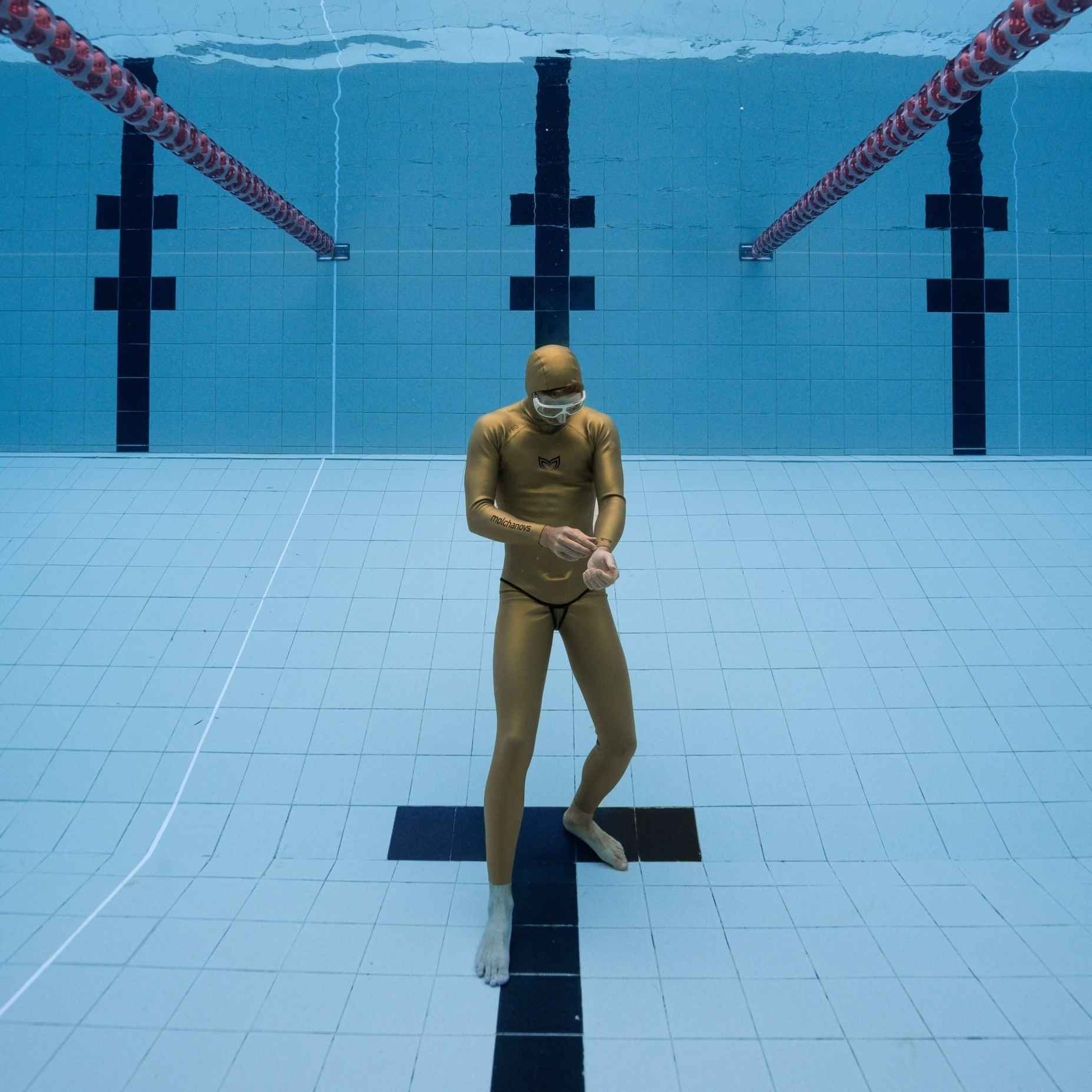
Nusy Horvath prepares for a static performance at a freediving pool competition © @below.the.wave.
At some point in every freediver's life, a thought might enter the mind, “Could I compete?” Not all freedivers are destined for world champ status in depth, nor does that have to be the goal. However, questions such as, “How long could I hold my breath, and how far could I go,” continue to compel divers worldwide. Fortunately, there is a way to dip your toes into competition without the total commitment of depth or the travel expense. The answer may be found as close as your local pool.
While pool competitions may not get the same attention as depth, they should because they offer more opportunities worldwide, making it easier to gain competitive experience. Pool competitions are for everyone; and as newbies, you’ll even get the chance to brush shoulders with world champs who compete on the pool circuit. If you are curious or if you know you want to compete in freediving, here are ten reasons why pool competitions are a great way to get your feet wet.
1. Safer, More Controlled Environment
Pool comps take place in a predictable, controlled setting where elements such as currents, waves, thermoclines and visibility issues are kept at bay. This reduces stress and makes it easier to focus purely on technique and competitive flow.
2. Ideal for Learning Competition Protocols
Competition rules, surface protocols, countdowns, and white, yellow and red card procedures are all part of the game, and it’s easier to learn in a calm, stable environment. Learning how competitions are run ahead of time removes doubt and anxiety before competing in open water. The two main international agencies that competitions are registered under are AIDA and CMAS, and both have their own set of rules. You can read more about the rules and regulations, as well as the differences between the two agencies in our article here.
3. Boosts Confidence
Successfully completing a static (STA) or dynamic (DYN/DNF) performance builds psychological confidence. That confidence may carry you far in depth training, which is especially valuable when you start adding equalization to your dive.
 Pro Molchanovs freediver, Nusy Horvath, glides in DNF.
4. Easier to Control Physical Stress
Pool events allow you to focus on the basics: breathwork, relaxation, CO₂ tolerance, and technique, without dealing with more depth-specific concepts such as equalization, narcosis, or pressure-related challenges.
5. Lower Logistical Complexity
Pool competitions are simpler to produce, and therefore, more plentiful. They don’t require travel to open-water sites, long surface intervals, weather cancellations, or specialized safety equipment. This makes it simpler, cheaper, and less stressful for a first competition experience.
6. Fine-Tune Mental Skills
Competition can spike the adrenaline, increase tunnel vision and psychological pressure. Pool competitions allow you to focus on your mental game due to the simplicity of not having to operate in anything deeper than one meter underwater.
 Pro Molchanovs freediver, Florian Dagoury (aka Mr. 10 Minutes), completes his surface protocol after another successful STA.
7. Identify Weaknesses with Lower Stakes
Competitive freedivers constantly refine their processes, such as the warm-up, relaxation phase, turns, pacing, technique, and relaxation. Make a mistake with these in a depth competition, and there can be real consequences. However, in a pool competition, these “mistakes” can often become refinement opportunities.
8. Build Familiarity With Competition Culture
By keeping logistics and location, such as at a pool, simpler, you can spend more time learning about judges’ expectations, athlete briefings, warm-up etiquette, and other competitors' tips and tricks. This helps reduce overwhelm later at depth competitions, which tend to feel more formal and high-stakes.
9. Great For Building CO₂ & O₂ (Hypoxia) Tolerance
By training and competing in pool disciplines, Dynamic (DYN) and Static (STA), you can develop foundational tolerance that pays huge dividends at depth. In fact, many top depth divers train pool disciplines to strengthen their CO2 tolerance and hypoxia awareness. Even if you are a spearfisher with no plans to compete, dynamic training in a pool is a great way to prepare for your next trip.
10. Reduced Pressure of Meeting your Announced Performance (AP)
In depth competitions, you are limited to announcing your performance to no deeper than 5 meters beyond your personal best (PB). You must also achieve your Announced Performance (AP) in order to get a white card. However, in pool competitions, while you still need to achieve your AP, you can announce as little as 1 second for STA, or 1 meter for dynamic disciplines, and as long as your surface protocol is successful, you’ll get the coveted white card and points for the final achieved performance. This takes the pressure off you and allows you to focus solely on your performance.
 Molchanovs athlete, Zsofia Torocsik, sets a new DYN world record.
Ultimately, signing up for a pool competition is one of the smartest moves that a developing freediver can make. Even if your end goal is to be competing at depth, or not at all, training and competing in the pool lay the groundwork for long-term success. The skills, confidence, and familiarity gained in a pool setting translate directly to the unique challenges of depth, helping athletes avoid common pitfalls and progress more sustainably. Use the controlled environment to your advantage and give yourself the best possible start on your competitive freediving journey.
If you are interested in diving into competitive freediving and learning more about the process, subscribe to the Magazine for the latest articles, tips, stories, and competition reporting.
Leave a comment